
A decade ago, an adult who wanted nicotine without cigarettes had two real options: patches or gum. In 2026 the picture is transformed almost beyond recognition. The smoke-free nicotine market has exploded into a genuine spectrum of products — vaping in half a dozen formats, oral nicotine pouches, and the lingering cultural memory of traditional oral tobacco — each with its own experience, cost, legal status and ideal user. For the person trying to navigate it, the choice can feel bewildering, and the terminology doesn’t help, with the same words meaning different things depending on who’s using them. This guide maps the entire smoke-free landscape as it actually stands in the UK today: what each category is, how they differ, which suits whom, and the legal lines that separate them. Whether you’re a smoker weighing your first switch or an existing user curious about the alternatives, this is the lay of the land.
The Two Great Families: Inhaled and Oral
The smoke-free market splits cleanly into two families, and understanding the split organises everything else. The inhaled family is vaping: devices that heat e-liquid into an inhalable vapour, delivering nicotine through the lungs in a way that mimics the act of smoking most closely. The oral family delivers nicotine through the tissues of the mouth instead, with no inhaling at all — this includes traditional gum and lozenges, the newer nicotine pouches, and the historically significant but UK-banned category of oral tobacco. The two families feel completely different to use: vaping keeps the hand-to-mouth ritual and the throat sensation of smoking, while oral products are discreet, invisible and hands-free once in place. Neither is universally better; they suit different people and different moments, and a growing number of users keep a foot in both camps. The rest of this guide works through each in turn.
Vaping: The Dominant Inhaled Format
Vaping is the largest and most visible smoke-free category, and since the 2025 disposables ban it has consolidated around rechargeable pod systems. These range from tiny prefilled pod kits — click in a sealed pod and vape, zero maintenance — to refillable pod kits where you add your own e-liquid, up to full tank systems for enthusiasts. For most people switching from cigarettes, a simple prefilled or refillable pod kit is the natural entry point: cigarette-like draw, straightforward operation, and a huge range of flavours. Anyone exploring the format will find modern rechargeable pod kits have become the standard recommendation, having replaced the disposables that dominated the pre-ban era. Vaping’s great strength is that it preserves the behavioural ritual of smoking — the hand movement, the inhale, the exhale — which is a large part of why it has proven such an effective switching tool where earlier nicotine replacements often failed.
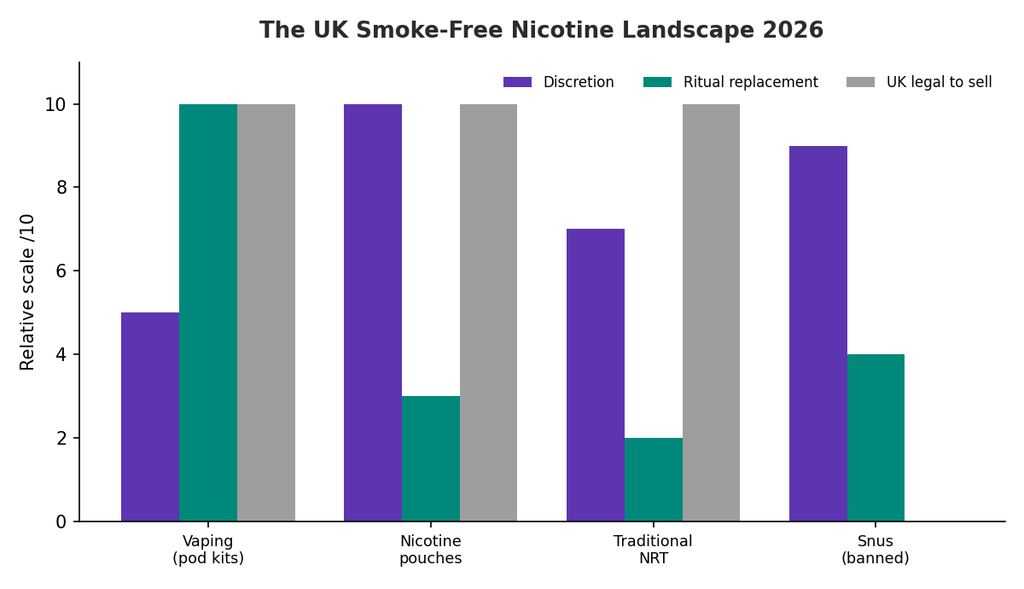
The UK smoke-free nicotine landscape in 2026 — the main categories and how they relate.
Nicotine Pouches: The Discreet Newcomer
The fastest-growing oral category is the nicotine pouch — a small, white, tobacco-free pouch placed under the upperlip, where nicotine absorbs through the gum over twenty minutes to an hour.Pouches produce no smoke, no vapour and no spit, which makes them uniquelydiscreet: they can be used almost anywhere, invisibly, which is a large part oftheir appeal.Awareness has climbed sharply, with UK adult awareness reachingaround 40% by 2024, up from 16% just three years earlier. They come in a widerange of flavours and strengths, with brands like Hayati Flavours offering popular options, and because they contain no tobacco, they occupy a very different legal position from the product people often confuse them with. That confusion is worth untangling properly, because it trips up a great many people — which brings us to the most misunderstood corner of the whole landscape.
The Snus Confusion
Here’s where the terminology gets genuinely muddled. Many people — especially on social media — call nicotine pouches ‘snus’, but the two are legally and materially different. Traditional snus is a moist oral tobacco product originating in Sweden over two hundred years ago, and crucially it contains actual tobacco leaf. Because it is a tobacco product, snus has been banned for sale in the UK since 1992 and remains so; it is legal to sell only in Sweden within the EU. Nicotine pouches, by contrast, are tobacco-free — they use plant fibre, nicotine and food-grade flavourings — which is precisely why they are legal to sell to adults in the UK where snus is not. Anyone genuinely curious about the distinction, the history and the law can find a clear explainer of what is snus and how it differs from the modern pouch. The short version: same placement under the lip, same broad idea, but tobacco versus tobacco-free — and that single difference decides their entirely opposite legal status.
Traditional Nicotine Replacement: Gum, Lozenges and Patches
The original smoke-free category still deserves its place: medically licensed nicotine replacement therapy — patches, gum, lozenges, inhalators, sprays — has decades of evidence behind it and remains a first-line quit-smoking tool recommended across the NHS. Its strengths are its regulatory pedigree and its suitability for people who want a clinically-backed, pharmacy-bought route with clear guidance. Its limitations, for some, are exactly what vaping and pouches address: NRT replaces the nicotine but not the ritual, and many heavy smokers find that gap is where their quit attempts falter. There’s no hierarchy here — for plenty of people, patches or gum are exactly the right tool, and combining a patch with a faster-acting product is a recognised approach. The point is simply that NRT is one option among several now, rather than the only game in town it once was.
Choosing by User, Not by Fashion
With the map drawn, how does an individual choose? By honest self-assessment rather than by whatever’s trending. If you most miss the physical act of smoking — the hand-to-mouth, the inhale — vaping is the natural fit, and a simple pod kit is the easiest entry. If discretion matters most — you want nicotine at your desk, on a flight, in a meeting, invisibly — nicotine pouches are purpose-built for it. If you want a clinically-backed, pharmacy-guided route, NRT remains excellent. And many people mix: a pod kit for the ritual moments, pouches for the discreet ones. The wrong approach is choosing by what an influencer uses or what looks coolest; the right one is matching the product to the moments in your day where nicotine currently lives, and to the parts of smoking you’re actually trying to replace. The variety of 2026 means there’s genuinely a right tool for most people — the task is finding yours.
The Legal Threads to Keep in View
A few legal lines run through the whole landscape and are worth holding onto. Tobacco snus: banned for sale, though personal possession isn’t criminalised. Nicotine pouches: legal for adults, and now brought under proper regulation by the Tobacco and Vapes Act 2026, which introduces an 18+ age-of-sale rule from late October 2026 along with marketing limits. Vaping: tightly regulated — 20mg nicotine cap, 2ml tanks, notified products, no more single-use disposables since June 2025. Across all of them, the direction of travel is the same: adult access preserved, youth access closed off, and the illicit fringe squeezed. For the consumer, the practical takeaway is constant regardless of category — buy from established UK retailers, check for compliant packaging and age verification, and stay clear of anything sold around the rules rather than within them.
How the Categories Overlap and Compete
It’s worth understanding that these categories don’t sit in neat isolation — they overlap, compete and complement one another in ways that shape the whole market. Vaping and pouches compete most directly, both offering discreet-ish, flavourful nicotine, and many users move between them or use both. NRT competes on the clinical, pharmacy-backed end, appealing to people who want structure and guidance. Snus, though banned, competes culturally — its name and heritage shape how people think about pouches, which is why the confusion persists. The upshot is a market where a user isn’t locked into one lane: you can start with a pod kit, add pouches for discreet moments, and adjust over time. This fluidity is a strength of the 2026 landscape — it means you’re not making a single irreversible choice but assembling a personal toolkit, and the best users treat it exactly that way, drawing on whichever product suits the moment rather than pledging allegiance to one category.
A Word on Buying Safely Across the Board
Whatever corner of the landscape you explore, one principle applies universally: buy from established, reputable UK retailers. This matters across every category — for vaping, it ensures notified, compliant, genuine products rather than counterfeits; for pouches, it ensures legal tobacco-free products with proper age verification; and it keeps you clear of the illicit market entirely, including anyone trying to sell banned snus. The checks are quick: look for compliant packaging, clear ingredient and strength information, age verification at purchase, and a real UK business behind the store. The counterfeit and grey-market fringe is the one genuinely risky part of the whole smoke-free landscape, and staying out of it is simply a matter of where you shop. A trusted retailer turns the entire safety question into a single good decision made once, which is exactly why experienced users settle on their sources and stick with them.
The Role of Personal Preference
If there’s a single principle that ties the whole landscape together, it’s that personal preference should drive your choices more than trends or other people’s opinions. The market’s variety exists precisely so that different people can find what suits them — the ritual-lover and the discretion-seeker, the switcher and the long-term reducer, the fruit fan and the menthol devotee. What works brilliantly for a friend may not suit you at all, and that’s not a problem to solve but the point of having options. The best approach is to try things with an open mind, pay attention to what you actually enjoy and stick with, and build your personal setup around that rather than around what’s fashionable or most-hyped. The users who succeed long-term are almost always the ones who found products they genuinely like, because enjoyment drives consistency and consistency is what keeps people off cigarettes. Trust your own experience over the noise.
Frequently Asked Questions
Is vaping or are pouches better for a first-time switcher? Neither is universally better — vaping suits those who want to replace the ritual of smoking, pouches suit those who want discretion, and many use both. Are all these products legal? Vaping and tobacco-free pouches are legal for adults; traditional tobacco snus is banned for sale. Which is cheapest? All are a fraction of smoking’s cost, with refillable vaping edging cheapest. Do I have to pick just one? No — a two-product approach covering ritual and discreet moments often works best. And is any of this safe? All are considered substantially less harmful than smoking by UK health bodies, though none is risk-free, and all are for existing adult nicotine users only. The landscape’s variety means there’s genuinely a suitable option for most people making a switch.
The Bottom Line
The UK’s smoke-free nicotine landscape in 2026 is richer, more varied and better regulated than ever — a genuine spectrum from inhaled vaping in its many forms to discreet oral pouches to the clinical reliability of traditional NRT, with the historical curiosity of banned snus explaining much of the terminology confusion along the way. For the adult smoker looking to switch, that variety is a gift: there is very likely a product, or a combination, that fits your life and the specific parts of smoking you’re trying to leave behind. Choose honestly, buy genuine, and treat the whole category the way it’s meant to be treated — as a set of tools for adults who already use nicotine. As always: everything here is for those aged 18 and over who already smoke or use nicotine, and for anyone else, the best option in the entire landscape remains none at all.