
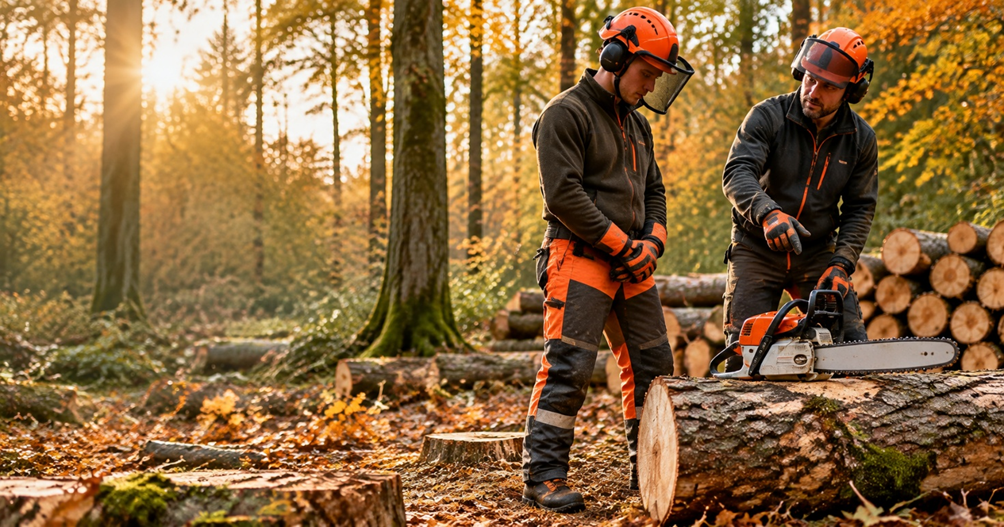
No licence is needed to own or use a chainsaw on your own land in the UK. Training is expected if you use one for work, and most employers, clients and insurers will ask to see a certificate.
The best place for a beginner to start is the City & Guilds NPTC Level 2 Certificate of Competence in Chainsaw Maintenance and Cross-Cutting (0039-20), which many people still call CS30. Training centres such as Brampton Valley Training in Towcester, Northamptonshire, deliver accredited NPTC and Lantra courses of this kind.
Chainsaw Course Key Facts at a Glance
- Length: usually 2 days of training, with the assessment often on a separate day.
- Cost: roughly £350 to £600. Recent college listings show £490 to £550.
- Minimum age: 16, with no experience needed.
- Kit: the provider supplies the saw. You bring your own protective clothing.
- Next step: Felling Small Trees up to 380mm (0039-21, formerly CS31).
Do You Need a Licence to Use a Chainsaw in the UK?
There is no chainsaw licence in the UK, and nothing in the law stops you from cutting wood on your own property. The rules change when the saw becomes part of a job.
The Law in Three Points
- The Health and Safety at Work etc. Act 1974 puts a general duty on employers and the self-employed to provide health and safety training.
- The Provision and Use of Work Equipment Regulations 1998 (PUWER) say anyone who uses work equipment must have had adequate training.
- The Health and Safety Executive (HSE) says a worker should hold a relevant certificate of competence before cutting on or in a tree, unless they are in training and properly supervised.
Farms have a narrow exception. The certificate expectation applies mainly to first-time chainsaw users, and the HSE lists exemptions for people who used a chainsaw before 5 December 1998 and carry out routine tasks. Even then, the operator must still be competent under PUWER.
Why the Word “Should” Does Not Let You Off
The HSE uses “should” rather than “must”, and some people treat that as a loophole. It is a weak one. HSE guidance carries real weight if an accident happens, and a certificate is the simplest proof of competence you can show. If you are paid to use a chainsaw, expect clients to ask for one.
Where Do You Fit?
| Your situation | Legal position | What to do |
| Homeowner cutting on own land | No certificate required. | Take a short course anyway. |
| Gardener or landscaper | Competence is required at work. | Get the NPTC maintenance and cross-cutting certificate. |
| Farm or estate worker | Competence is required, with narrow exemptions. | Check the HSE agricultural rules, and certify if unsure. |
| Firewood seller | You are working with a saw commercially. | Get certified. |
| Volunteer or community group | Competence is needed, and supervision is allowed during training. | Ask the organiser what they require. |
| Tree surgeon or forestry worker | A certificate is expected for each task. | Certify for every task you do. |
Terms That Confuse Beginners
- Licence: this does not exist for chainsaws in the UK.
- Ticket: trade slang for a certificate of competence.
- Certificate of competence: proof that you passed an independent assessment for one specific task.
- CS30 and CS31: the old unit names, now replaced by 0039-20 and 0039-21.
Which Chainsaw Course Is Right for You?
The right course depends on what you plan to cut, not on which title sounds more impressive. Training is tied to the task. A cross-cutting certificate does not cover felling, and a felling certificate does not cover working in a tree.
If you are searching for chainsaw courses in Northamptonshire, the course library at Brampton Valley Training is a useful example of how a good centre groups its training. It splits courses into ground-based chainsaw, aerial, land-based machinery, utility arboriculture, pesticides, and health and safety, so you can pick the lane that matches your work.
The Three-Question Course Picker
Answer these in order, and you will usually land on the right course.
- Is the saw for work or for your own land? For work, you need an NPTC or Lantra certificate. For your own land, a one-day course may be enough.
- Will you only cut fallen timber, or fell standing trees? Fallen timber points to maintenance and cross-cutting. Standing trees add the felling course.
- Will you ever leave the ground? If yes, you need separate aerial units, and you should budget for more training time.
Match Your Goal to a Course
| If you want to… | Start with | Why |
| Trim fallen branches and cut logs at home | A one-day domestic course, or 0039-20 | Covers safe saw handling and maintenance. |
| Process firewood | 0039-20 | Cross-cutting is the core skill. |
| Fell small garden or woodland trees | 0039-20, then 0039-21 | 0039-21 requires 0039-20 first. |
| Work in landscaping or grounds care | 0039-20, then 0039-21 | Employers usually want both. |
| Work from a rope and harness | 0039-20, then specialist units | Aerial work is a separate qualification. |
| Start a career in tree care | The full pathway | Build up unit by unit. |
The Two Beginner Qualifications
Chainsaw Maintenance and Cross-Cutting (0039-20, formerly CS30). City & Guilds describes this as covering chainsaw maintenance and cross-cutting trees at ground level. Timber under low and moderate tension is included. Timber under extreme tension, such as windblown trees, is not. Colleges describe it as the first step before other chainsaw courses.
Felling Small Trees up to 380mm (0039-21, formerly CS31). This course builds on the first and teaches you to fell and process small trees up to 380mm in diameter. Colleges ask for 0039-20 before you enrol.
Not a Beginner Course
- Tree Climbing and Aerial Rescue (0039-22) and Using a Chainsaw from a Rope and Harness (0039-23) are Level 2 aerial units.
- Felling medium trees, large trees and individual windblown trees are Level 3 units.
- Skip these until you have the basics and some time using a saw.
Short Courses for Home Users
Some colleges run one-day courses for people using a saw on their own land. These usually carry no formal qualification, only a certificate of attendance. One college’s day covers protective clothing, refuelling, air filter cleaning, chain sharpening and cross-cutting cord wood. They suit a homeowner well, but they will not satisfy an employer who wants an NPTC certificate.
How Chainsaw Certification Works: Training vs Assessment
Being trained and being certified are two different steps. Many beginners only find this out when they see a second fee on the booking page.
- Training. An instructor takes a small group through safety checks, maintenance and cutting techniques.
- Assessment. An approved assessor tests you one to one, with practical work and oral questions.
- Certificate. If you pass, you receive a certificate of competence and, usually, a card.
HSE guidance says assessment should be independent of the training for most advanced skills. That is why it is often booked on a separate day.
There is also an integrated route. On Lantra’s integrated training and assessment courses, the training provider also assesses you. The HSE treats this approach as suitable for lower-risk tasks, such as basic chainsaw maintenance.
What Happens on Assessment Day
- Expect a saw check before any cutting starts.
- Expect maintenance tasks, such as checking the chain and bar.
- Expect cross-cutting while the assessor watches.
- Expect oral questions about hazards, protective equipment and emergency plans.
- Wear your full kit and treat it like a normal working day.
What If You Do Not Pass?
You can normally retake the assessment, sometimes after extra training. Ask your provider about re-sit costs before booking. One college warns that missing your booked assessment date can bring additional charges.
Do Certificates Expire?
NPTC says most of its Certificates of Competence are issued for life, with a few exceptions that are not chainsaw units. That does not mean you can stop learning. The refresher section below explains why.
What to Expect on a Beginner Chainsaw Course
Entry Requirements
- Age: candidates must be at least 16.
- Experience: colleges list no formal entry requirements for 0039-20.
- Fitness: the work involves lifting, carrying and long days outdoors, so a reasonable level of fitness is expected.
- Health concerns: call the provider before booking if you have a mobility or health issue.
A Typical Timeline
- Day one: safety briefing, protective clothing, risk assessment, how the saw works, daily checks and sharpening.
- Day two: setting up for work, cross-cutting practice, moving and stacking timber, and emergency planning.
- Assessment day: a one-to-one practical test with questions.
The felling course is longer. One college runs four training days plus an assessment day. Another packages both qualifications into five days with a half-day assessment.
Equipment: What You Get and What You Bring
Training providers normally supply the chainsaw. Some colleges charge a small hire fee, so ask when you book. You supply your protective kit.
| Item | Standard commonly requested |
| Forestry helmet with ear defenders and mesh visor | EN 397 |
| Chainsaw trousers | EN 381-5, Type A or Type C |
| Chainsaw boots | EN 381-3 |
| Chainsaw gloves | EN 381-7 |
Check the exact list with your provider before buying anything. Some colleges accept Type A front protection for ground-based domestic courses, while others ask for Type C all-round protection. One college says chaps and boot spats are not suitable for its training. For aerial work, the HSE’s Arboriculture and Forestry Advisory Group (AFAG) recommends Type C leg protection.
Day-One Packing Checklist
- Warm, waterproof layers to wear under your protective trousers.
- Waterproof gloves for breaks.
- A packed lunch and plenty of water.
- A notebook for the theory sections.
- Your booking confirmation and photo ID.
How Much Do Chainsaw Courses Cost in the UK?
A beginner course typically costs between £300 and £600, according to one UK trades guide. Recent college prices sit inside that range.
| Course | Price | Notes |
| Domestic chainsaw use (1 day) | £160 to £200 | No NPTC qualification. |
| Maintenance and cross-cutting (2 days) | £490 to £550 | Assessment on a separate day. |
| Maintenance, cross-cutting and felling (5 days) | About £530 | Plus a half-day NPTC assessment. |
| Felling small trees (4 days) | £830 | £686 tuition plus £144 assessment. |
Prices vary by centre and year. Some include assessment, while others charge for it separately. Read each listing closely.
The Full Cost of Getting Certified
- Course fee. Check whether it covers training only or assessment too.
- Assessment fee. Sometimes charged separately.
- Protective kit. Helmet, trousers, boots and gloves usually come from you.
- Saw hire. A small charge at some colleges.
- Travel and accommodation. More relevant if the nearest course is far away.
- Time off work. Especially for the five-day packages.
- Refresher or re-sit fees. These may arrive later.
Ways to Keep the Cost Down
- Hire kit if the provider offers it.
- Ask about group rates. One college will bring training to your premises for three or more candidates.
- Look into grants or employer support. Farm workers often share this tip.
- Avoid very cheap courses with no recognised certificate. One trades guide warns that employers may not accept them.
NPTC and Lantra: Who Awards Chainsaw Certificates?
Two names appear on most UK chainsaw certificates.
- City & Guilds NPTC issues Certificates of Competence. They are the best-known proof of chainsaw competence in arboriculture and forestry, and the usual route is training followed by independent assessment.
- Lantra Awards runs chainsaw maintenance and cross-cutting courses for both liquid-fuel and battery-powered saws, including integrated training and assessment options.
Neither is better in every case. The right choice usually depends on who you work for. If you are being hired, ask the employer or client which certificate they prefer before you book.
Why Choose a Local Provider Like Brampton Valley Training?
Travelling for training adds cost, and a local centre makes re-sits and refreshers easier to book. If you live near Northampton, Daventry, Brackley or Milton Keynes, a Towcester centre is within a sensible drive.
Brampton Valley Trainingis based at York’s Farm Business Centre in Towcester and describes itself as delivering accredited NPTC, City & Guilds and Lantra arborist training courses in Northamptonshire. Its website lists these accreditations:
- Arb Approved Contractor.
- City & Guilds NPTC Approved Centre.
- Lantra Approved.
- Safe Contractor Approved.
- Trustmark.
Its course library also covers more than chainsaw work. You will find utility arboriculture, pesticides, land-based machinery, and health and safety courses, which helps if you want to add skills later without changing provider.
Want to talk it through? Call 01327 831299 and describe what you plan to cut. They can tell you which course fits.
How to Choose a Good Chainsaw Training Provider
A cheap price tells you little. These seven checks tell you much more.
- Approved centre status. Ask whether the provider is approved by the awarding body, and request proof if in doubt.
- Group size. Small groups mean more time with the saw.
- Independent assessment. For NPTC certificates, the assessor should be separate from your trainer.
- What is included. Check the saw, kit hire, assessment fee and lunch.
- Cancellation and re-sit terms. Know the cost of missing a date.
- Recent reviews. Look for comments about instructors, not only the venue.
- The site. Ask about weather plans and how much time is spent actually cutting.
Five Questions to Ask on the Phone
- “Which awarding body certifies this course?”
- “Is the assessment on the same day or a separate day?”
- “What is the total price, including assessment and any saw hire?”
- “Which protective clothing standards do you accept?”
- “What happens if I need to re-sit?”
Red Flags
- No named awarding body.
- An online-only practical qualification.
- A price far below everyone else’s.
Online theory can help, but chainsaw skills are practical.
Refresher Training: Do Certificates Run Out?
Your NPTC certificate does not carry an expiry date. Skills fade, though, and the HSE recommends regular refresher training for all chainsaw operators.
- Occasional users: every two to three years.
- Full-time users: every five years.
The Forestry Industry Safety Accord (FISA) sets a five-year expectation. Participating forestry organisations ask contractors to show formally recorded chainsaw training within the previous five years. FISA says its scheme is a competence check, not a recertification.
A refresher does not have to repeat what you already know. Some people choose a new unit instead, which adds to their skills at the same time.
Common Mistakes When Booking Chainsaw Training
| Mistake | Better approach |
| Buying kit before checking the list. | Confirm the standards with your provider first. |
| Jumping straight to felling. | Complete 0039-20 first, because 0039-21 requires it. |
| Forgetting the assessment fee. | Ask for the total price in writing. |
| Treating a short course as an NPTC certificate. | Check what qualification you will actually receive. |
| Choosing on price alone. | Compare what is included and who certifies it. |
| Skipping questions about hire and re-sits. | Ask before you pay. |
What Next After Your First Course?
- Felling Small Trees up to 380mm (0039-21) for garden and woodland work.
- Tree Climbing and Aerial Rescue (0039-22) and Using a Chainsaw from a Rope and Harness (0039-23) for tree surgery.
- Level 3 units for larger trees and complex situations, after plenty of experience.
Climbing work adds its own kit and rules. Tree climbing equipment must comply with the Lifting Operations and Lifting Equipment Regulations (LOLER). Give yourself time to build skill before moving on.
Forestry England notes that certificates of competence were introduced in the early 1990s to improve safety, yet felling is still one of the most dangerous jobs in forestry. A certificate is a starting point, and practice builds the rest.
Frequently Asked Questions About Chainsaw Courses
Do you need a licence to use a chainsaw in the UK?
No. The UK has no chainsaw licence. If you use one for work, health and safety law expects you to be trained and competent.
Can you use a chainsaw without a certificate in the UK?
On your own land, yes. At work, you should hold a relevant certificate of competence.
How long does a chainsaw course take?
The maintenance and cross-cutting course usually takes two days, plus an assessment day. A combined felling package runs about five days.
How much does a chainsaw course cost in the UK?
Entry-level courses generally cost £300 to £600. Recent college prices show £490 to £550 for the two-day course.
What is the difference between CS30 and CS31?
CS30 (now 0039-20) covers maintenance and cross-cutting. CS31 (now 0039-21) covers felling small trees up to 380mm.
Do you need your own PPE for a chainsaw course?
Usually, yes. Providers normally supply the saw, and you bring a helmet, chainsaw trousers, boots and gloves.
How long is a chainsaw certificate valid?
NPTC issues most chainsaw certificates for life. The HSE still recommends refreshers every two to five years.
What age can you take a chainsaw course?
Colleges generally set the minimum age at 16.
Final Thoughts: Book Your Chainsaw Course with Brampton Valley Training
If you are in Northamptonshire or the surrounding counties, Brampton Valley Training is a practical place to start. Call 01327 831299 to ask which NPTC or Lantra course suits your work.
There is no chainsaw licence in the UK, but that does not mean there are no rules. If chainsaw work is part of your job, you need to be trained and competent, and a recognised certificate is how you prove it. If you only cut wood at home, a one-day course will teach you more than months of guessing.
Your Five-Step Plan
- Decide what you will cut and whether it is for work.
- Pick the matching course using the three-question picker above.
- Shortlist two or three approved providers and compare what is included.
- Book early, because autumn and winter dates fill quickly.
- Buy your protective kit only after the provider confirms its list.
Whatever you choose, never use a chainsaw without full protective gear. The HSE’s own estate worker guidance says the risk of injury from the saw cannot be controlled any other way.